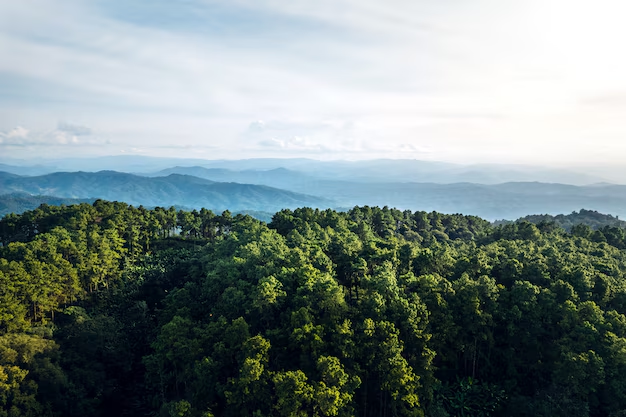
In recent years, Gorontalo, a small province on Sulawesi Island, has caught attention for an unexpected reason. While much of Indonesia faces global scrutiny over deforestation, Gorontalo is carving a new image, a region showing that forest use and green industry can actually coexist.
A Sustainable Shift in Gorontalo
Gorontalo’s approach is not about denying industrial activity but redefining it. The province has become one of Indonesia’s centers for wood pellet production, contributing nearly 29.96% of the national total. These wood pellets, made from sustainably sourced biomass, are helping Indonesia move toward renewable energy while reducing dependence on fossil fuels.
According to official data, national production of wood pellets grew from 103,356 cubic meters in 2020 to 333,971 cubic meters in 2024, almost tripling in just four years. This growth was supported by 35 wood pellet plants nationwide, with a total licensed capacity of 3.18 million cubic meters per year.
Governance at the Core, The SVLK System
At the heart of Gorontalo’s success is the Timber Legality and Sustainability Verification System (SVLK). This framework ensures that all forestry products in Indonesia come from legal and sustainable sources, mainly Industrial Forest Plantations (HTI)—not from natural forest clearance.
Erwan Sudaryanto, Director of Forest Product Processing and Marketing, explains that SVLK provides a strong legal foundation and independent auditing. “Every forest product harvested, transported, and traded in Indonesia must be legal and sustainable,” he said in a Jakarta forum earlier this year.
This certification system is not only domestic regulation—it’s a passport to global trade. Markets in Japan, South Korea, and the European Union now demand proof of sustainability before accepting biomass imports. With SVLK, Indonesia—and particularly Gorontalo—stands at an advantage in meeting these requirements.
Economic Growth Without Forest Loss
The term deforestation Gorontalo is often misunderstood. While “deforestation” usually implies forest destruction, in this context, it reflects the ongoing debate on how to manage forest-based industries responsibly. Gorontalo’s example shows that production and preservation can go hand in hand.
Indonesia’s forestry authority has identified 10.36 million hectares of potential land for industrial forest and energy-crop development. This means the country can expand its biomass and timber sectors without cutting into natural forest cover.
By prioritizing replanting, regulated harvesting, and community-managed forestry, Gorontalo demonstrates how local economies can thrive through green-based industrial strategies.
Baca juga: Tips Memilih Jasa Travel Malang Surabaya yang Aman dan Terpercaya
International Recognition and Local Impact
Global partners have started noticing. Japan and South Korea, for instance, have entered long-term biomass import agreements with Indonesian suppliers, highlighting Gorontalo as a reliable source.
Locally, the benefits are tangible. Communities around HTI areas gain employment opportunities, training in sustainable practices, and better economic stability. Instead of viewing the forest merely as a resource to exploit, many now see it as an asset to manage wisely.
This model is not without challenges—monitoring compliance, balancing production costs, and maintaining transparency remain crucial. Yet, it shows real progress toward the “green industry” vision promoted by Indonesia’s energy transition agenda.
Data, Policy, and Practical Lessons
-
Forest-based industry growth: Threefold increase in production within four years shows market demand for clean energy materials.
-
Governance tools: SVLK acts as both a quality standard and a trade assurance system.
-
Sustainable expansion: 10.36 million hectares of potential land for green industry development reduces the pressure on natural forests.
-
Community participation: Involving local residents ensures shared benefits and stronger environmental stewardship.
These policies align with Indonesia’s commitment under global frameworks such as the Paris Agreement and the Sustainable Development Goals (SDGs), particularly Goal 12 (Responsible Consumption and Production) and Goal 15 (Life on Land).
Why Gorontalo Matters
Gorontalo’s model offers a real-world case study in how developing regions can balance economic progress with ecological responsibility. Rather than framing deforestation as an inevitable consequence of growth, the province reframes it as an opportunity for transformation—from extractive industry to sustainable bioeconomy.
This shift mirrors a larger national strategy: turning forestry into part of the climate solution, not the problem. The success here could serve as a blueprint for other regions in Indonesia and beyond.
Gorontalo’s experience shows that the path away from deforestation doesn’t mean halting development, it means doing it smarter. Through systems like SVLK, renewable energy goals, and local participation, Indonesia is building a green industry model that others can learn from.
The lesson is simple: sustainability works best not as a slogan, but as a system. Gorontalo proves that with good governance, transparency, and shared responsibility, even regions once linked to deforestation can become examples of a greener future.
Don’t forget to share our article staiibsi.ac.id, follow our newsletter. Thank you!
Leave a Reply